A Tale of Two Cities Part I: How Chicago's Field Museum Honored Milwaukee's Taxidermy Pioneer While MPM Looked the Other Way
- SaveMPM
- Dec 4, 2025
- 3 min read

In the history of American natural history museums, few stories carry more irony—or heartbreak—than the divergent paths of the Chicago Field Museum and the Milwaukee Public Museum, two Midwestern institutions born within a decade of each other and shaped, in their earliest days, by the same taxidermy genius: Carl Ethan Akeley.
Akeley arrived in Milwaukee in 1886 as a young, ambitious taxidermist hired by the Milwaukee Public Museum (MPM), then barely a decade old. During his six-year tenure, he did something revolutionary: he created what many scholars consider the world’s first fully immersive habitat diorama—the Muskrat Group of 1890. This diorama wasn’t a simple case mount. It was a Milwaukee first: a marsh scene complete with water, reeds, mud banks, environmental lighting, and an entire muskrat family engaged in daily life.
It was the beginning of what the museum world later called the “Milwaukee Style”—a fusion of art, science, and storytelling that would become the gold standard for natural history exhibits.
Yet MPM didn’t show much enthusiasm for Akeley’s radical vision. When he proposed entire halls of immersive ecosystems—what we now think of as classic diorama environments—the museum hesitated. Funding was tight, priorities were scattered, and immersive “habitat scenes” were seen by some as unnecessary embellishments. Frustrated by a lack of institutional support, Akeley left Milwaukee in 1892. Chicago, however, embraced him.
Chicago’s Long Memory — Milwaukee’s Short One
Fast-forward nearly nine decades. In 2015–2016, the Field Museum undertook a remarkable project: completing a full Akeley-style striped hyena diorama, based on a partially begun habitat concept from the 1920s—interrupted by the Great Depression and deferred for almost 90 years.

Original Field Museum Striped Hyena Diorama Carl Akeley taxidermy - 1899
Photo courtesy of the Field Museum of Natural History (Chicago)
This wasn’t nostalgia. It was stewardship.
Using Akeley’s own archival photographs of the Somali landscape (taken during his 1896 African expedition—the same year these hyenas were collected), the Field Museum’s team rebuilt the scene exactly as Akeley envisioned. Scenic artist Aaron Delehanty recreated the background painting using the same atmospheric perspective and lighting techniques pioneered in Milwaukee. Museum educator Emily Graslie documented the entire restoration, calling it:
“A full-scale habitat diorama… recreating a specific moment in time, at a specific place on Earth.”
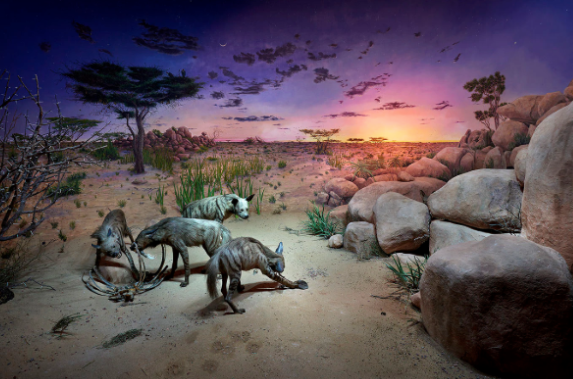
New Hyena group Habitat Diorama created in 2015 using original Carl Akeley striped hyena group
Photo courtesy of the Field Museum of Natural History (Chicago)
Visitors are now able to stand mere feet from Akeley’s hyena mounts—surrounded by a recreated environment so immersive that many say it feels like dusk in the Horn of Africa.
Chicago didn’t just preserve the past; it activated it.
Meanwhile in Milwaukee…
The contrast is stark. The very museum that gave birth to the habitat diorama is now preparing to discard or deconstruct almost all of its historic “Milwaukee Style” environments as it relocates to a new building in 2027.
How did two institutions, born of the same era and sharing the same early innovator, take such different paths?
Both museums:
emerged from 19th-century civic pride,
were built on public trust,
placed art and science side-by-side,
and once claimed immersive dioramas as core to their educational mission.
But in recent years, their philosophies diverged.
Where Chicago sees dioramas as enduring educational assets worth restoring, Milwaukee’s current leadership frames them as outdated, bulky, or “non-essential”—moving instead toward a future of screens, projections, and replicable digital experiences.

Beaver diorama Milwaukee Public Museum circa 1966
MPM’s approach abandons its own origin story.
Why This Matters
The Field Museum’s hyena project proves something crucial:
**Traditional, handcrafted dioramas are not relics—
they are art, science, culture, and storytelling fused into one.**
And when preserved or recreated, they continue to teach new generations with unmatched clarity and emotional impact.
Chicago recognized this. Milwaukee once invented this. But today, only Chicago honors it.
As MPM prepares to leave its historic building, it risks leaving behind not just cases and mounts—but a legacy it once pioneered and that other museums around the world revere as foundational.
What Happens Next?
Milwaukee can still choose the path of stewardship. It can follow Chicago’s example by:
restoring its most iconic dioramas,
responsibly relocating movable groups,
and designing new immersive environments rooted in the “Milwaukee Style.”
Chicago has shown it can be done affordably, beautifully, and with deep respect for the past.
Milwaukee must decide: Will we reclaim our heritage—or watch another city celebrate the legacy we forgot?


Comments